A
personal walkthrough of the Whitney Biennial 2026 at the Whitney Museum of American Art, with stops at Precious Okoyomon, Ali Eyal, Norman Lewis, and “Untitled” (America).
The hardest part about looking at art in abundance is how much time you spend in front of each piece. This is where my ignorance comes in handy. At major art shows like the Whitney Biennial, it’s best to use what you don’t know to fuel your intuition on whether you’re moved by a piece or not. As with Biennials of the past, I’m often six feet away from work I’ve never seen, by an artist I’ve never heard of, offering a message I’m more than likely oblivious to. And that’s okay. That’s the whole point of coming to the show, actually. I let the other art institutions serve me the stuff I know and have been programmed to love, but here, at the Whitney, the joy of this art experience is being titillated with the notion of, “What the fuck am I looking at right now?”
Which brings me to this little game I play. It has no name, and I’m Ready Player One. It’s me against what the artist is trying to say with their creation. It goes like this. I encounter the art, look at it, take in the details from afar as I approach, then get as close as I can to the work before gallery security says something like, “Ayo my man, you good?” Then I back out one more time and take an educated guess at what this piece is about without reading the wall placard or whatever the introductory paragraph says.
If there was a pie chart for my accuracy in discerning what I’m gazing at, it would have three slices. The first third would be me being dead wrong. The second third would be me getting it right. The last third would be utter confusion, labeled, “I got nothing.”
Playing this game in an art institution is easy mode, because the answers are provided by the artist. But when I play it on the streets, it’s led fully by personal taste. I sum up my thoughts on every sticker, wheat paste, mural, throwie, and rappel piece slathered on old New York architecture into two categories. Shit’s dope. Shit’s wack.
Back to the Whitney.
Precious Okoyomon on the Eighth Floor
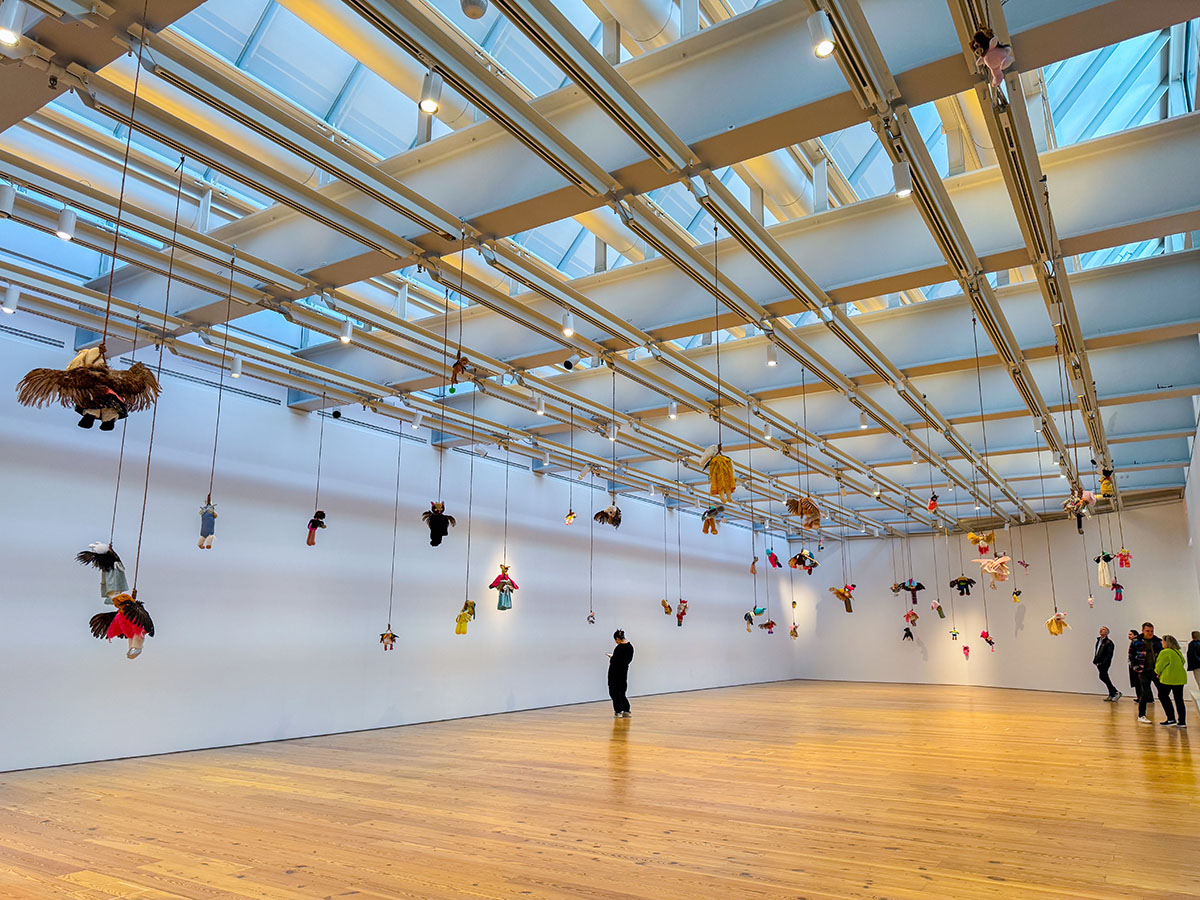
When the elevator doors opened on the eighth floor, the first thing I saw was a huge open space filled with plush figures suspended in the air. I could not tell what I was looking at. I knew they were colorful. I knew they were cute. I knew they were hanging. But I know enough about art to know that whatever you think you are seeing in the first few seconds is usually incomplete.
At first, I just wandered, trying to gather clues. Then I saw the wings. Wings on plush dolls. Then I saw the nooses.
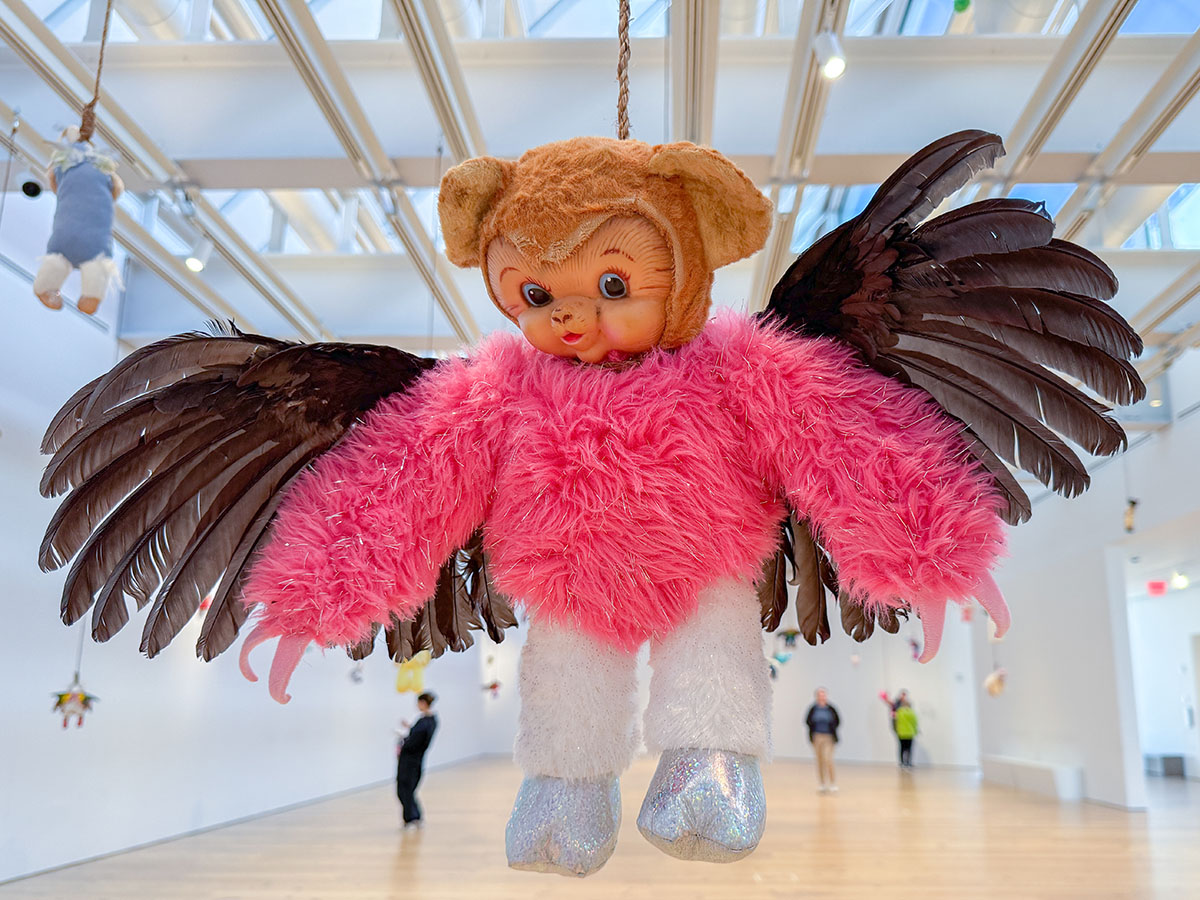
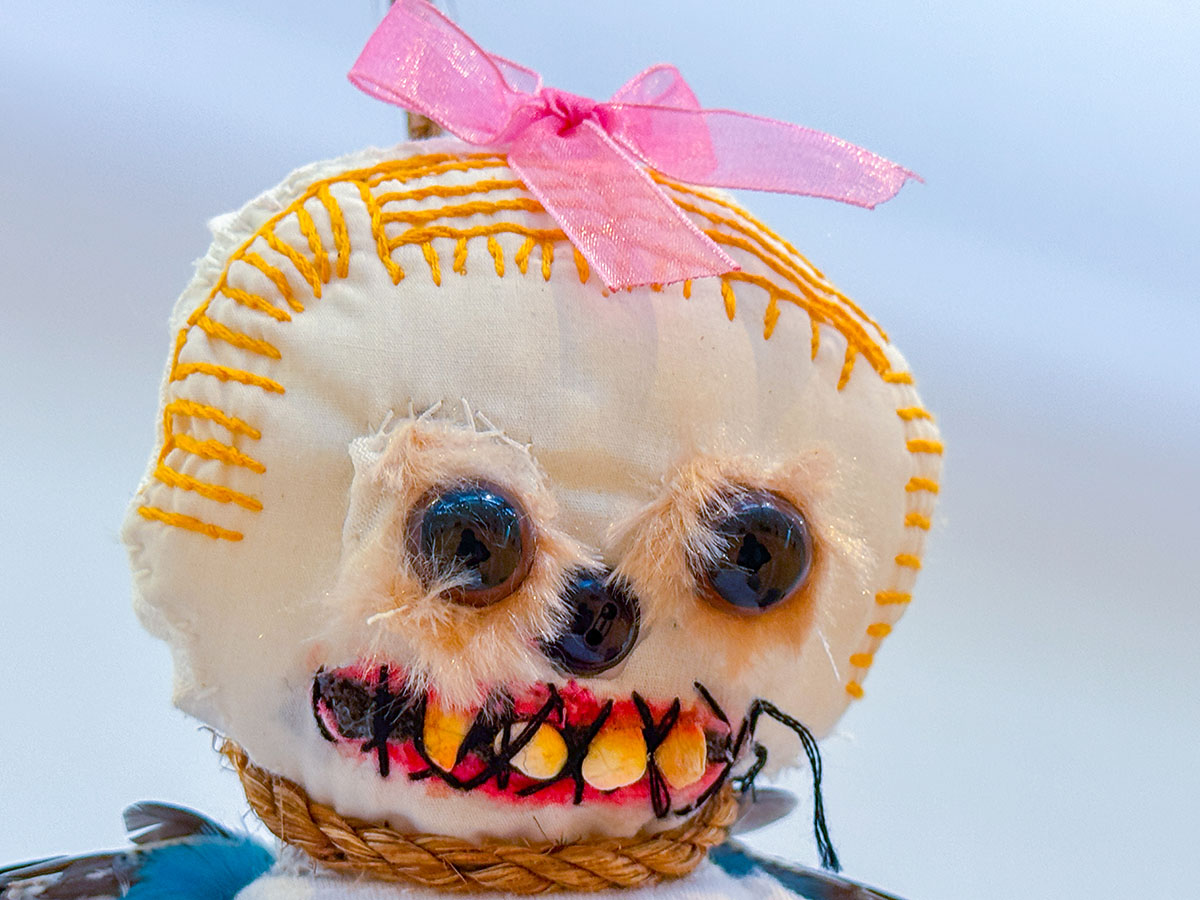
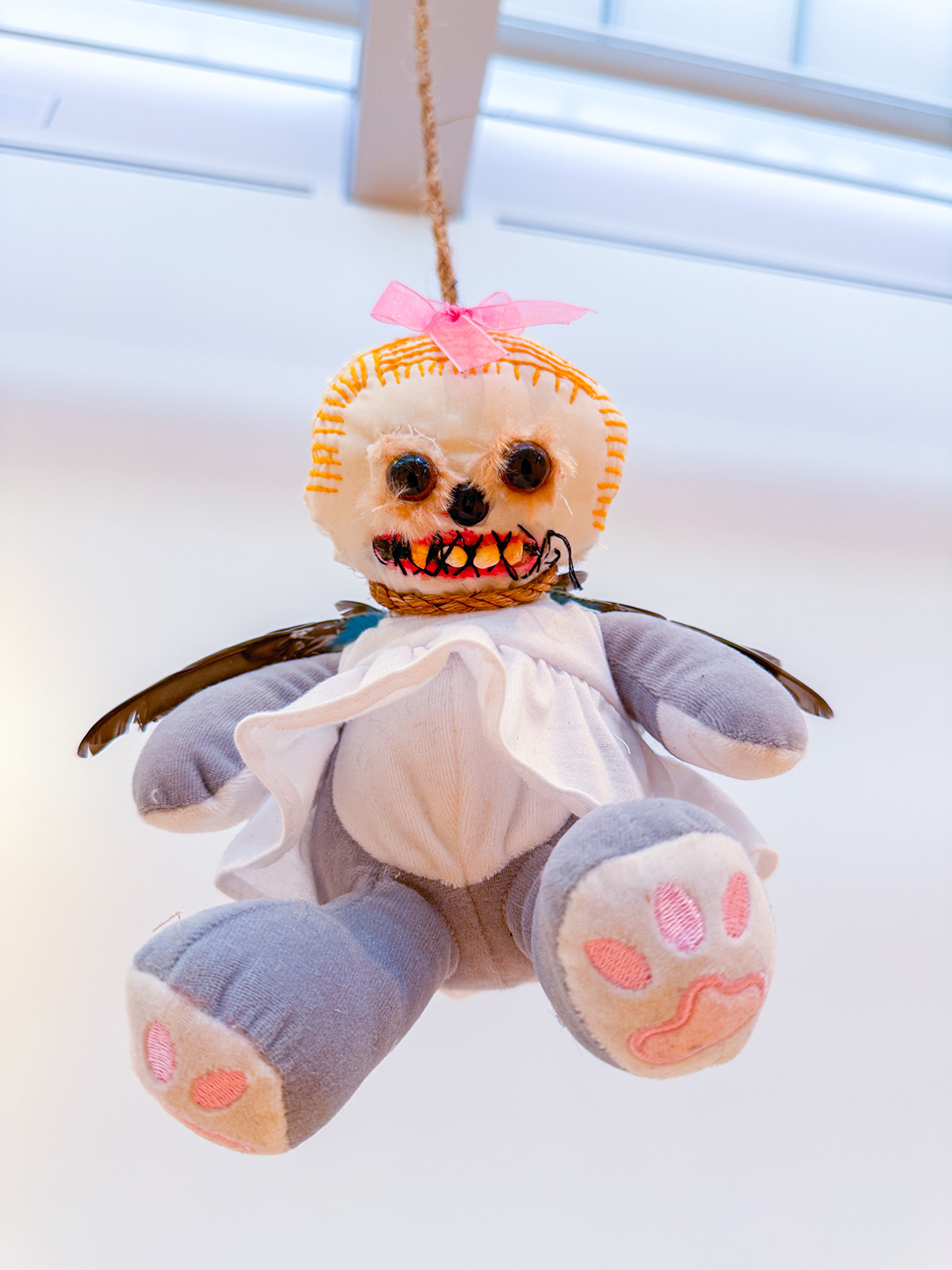
Once I saw the nooses, the room changed. I understood more, but not fully. Some of the dolls looked absolutely adorable. Some looked like nightmare fuel. One of them was a stitched-mouth gray bunny with a pink bow and teeth like a horror movie. I couldn’t stop looking at it. Another had a rubbery doll face, pink fur, glitter boots, and black feathered wings that looked like they belonged on a vulture.
This was all enthralling, but I had to read the wall. What I was immersed in was Precious Okoyomon’s Everything wants to kill you and you should be afraid, the site-specific installation that takes the entire eighth-floor gallery for itself.
The wall gave me the answers. Fifty-five suspended creatures with bodies sewn together from taxidermied bird wings and discarded children’s toys salvaged from thrift stores. The sculptures hang from nooses in reference to the history of racial violence in the United States. For Okoyomon, the angel-like forms are rife with contradictions. Marked by both death and eternal life. Defined by flight yet subject to gravity. Perpetually burdened by the weight of grief.
I turned and looked at the room again. I got it.
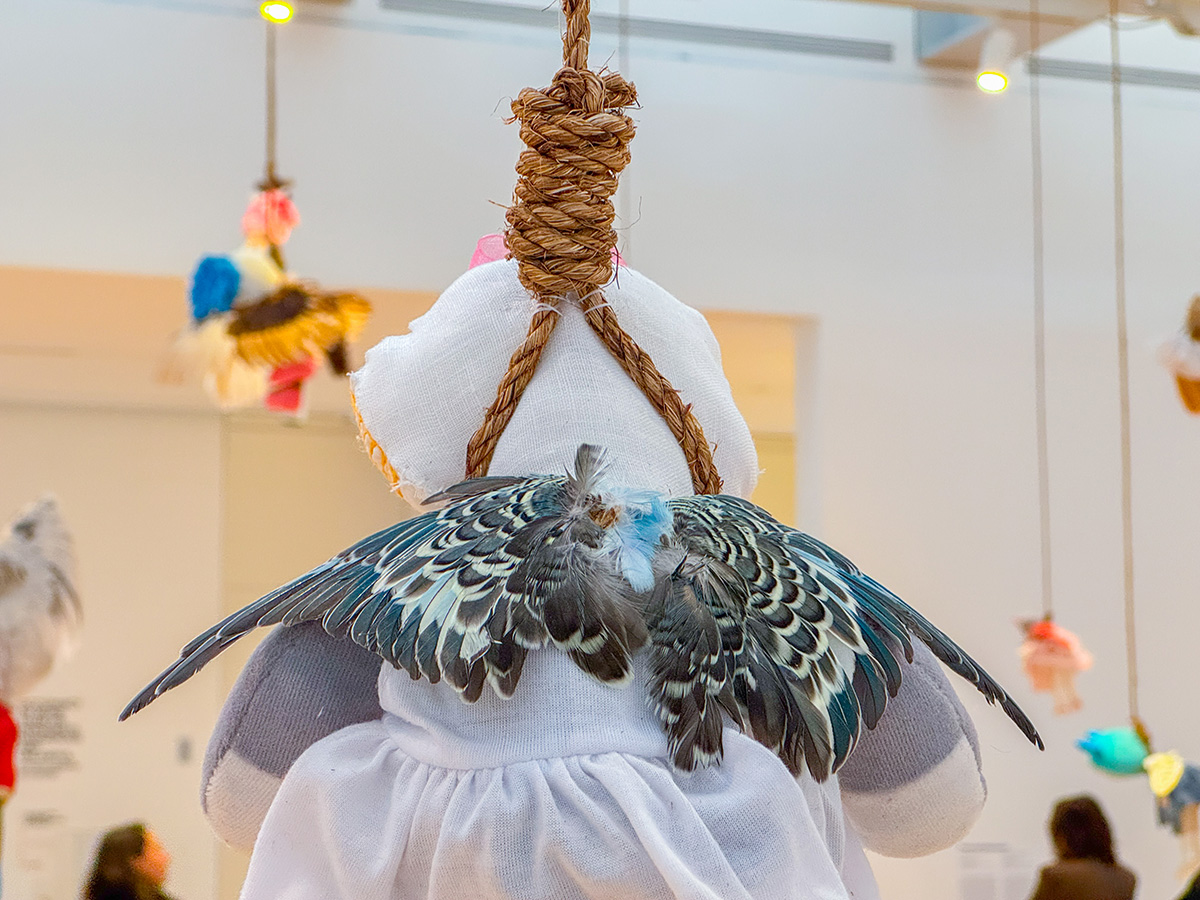
Days later, looking back at the photos on my phone, my mind crept to Strange Fruit, written by Abel Meeropol and made famous by Billie Holiday. The plushes looked like the fruit you’d find in a sugary cereal box. Easy on the eye, but really just a ticket to the breakfast-to-diabetes pipeline. The art installation could have easily been called Strange Fruit, but that’s too on the nose. The title Okoyomon chose makes more sense the more you think about it.
Here’s my take on the title. I agree with the first half and I disagree with the second. Everything is trying to kill me, yes. My OG told me as a kid, you can’t leave life alive, and making it to my late forties, I found the quip to be facts, bro. Between the food, the air, the screens we stare into, the indoctrinating ads, and the general wear and tear of being on this ghetto-ass rock orbiting a dumpster fire, life can feel like a full-body experience of infinite cuts. A trillion touchpoints vetting you for your inevitable demise.
Damn, this coffee is hitting.
Anyway, the part I reject is the second part of the title. To be afraid. Yeah, cuss that.
A Whimsical Atrocity: Ali Eyal’s Look Where I Took You
Somewhere on a lower level, I struck a curious pose in front of a painting that stopped and frisked me. A Ferris wheel with what looked like severed heads in place of passengers. A huge black creature crawling across the ground. Figures clutching their own faces. An elephant watching from the side. A white horse off in the corner of what used to be a normal amusement park. The composition was playful. The story was devastating.
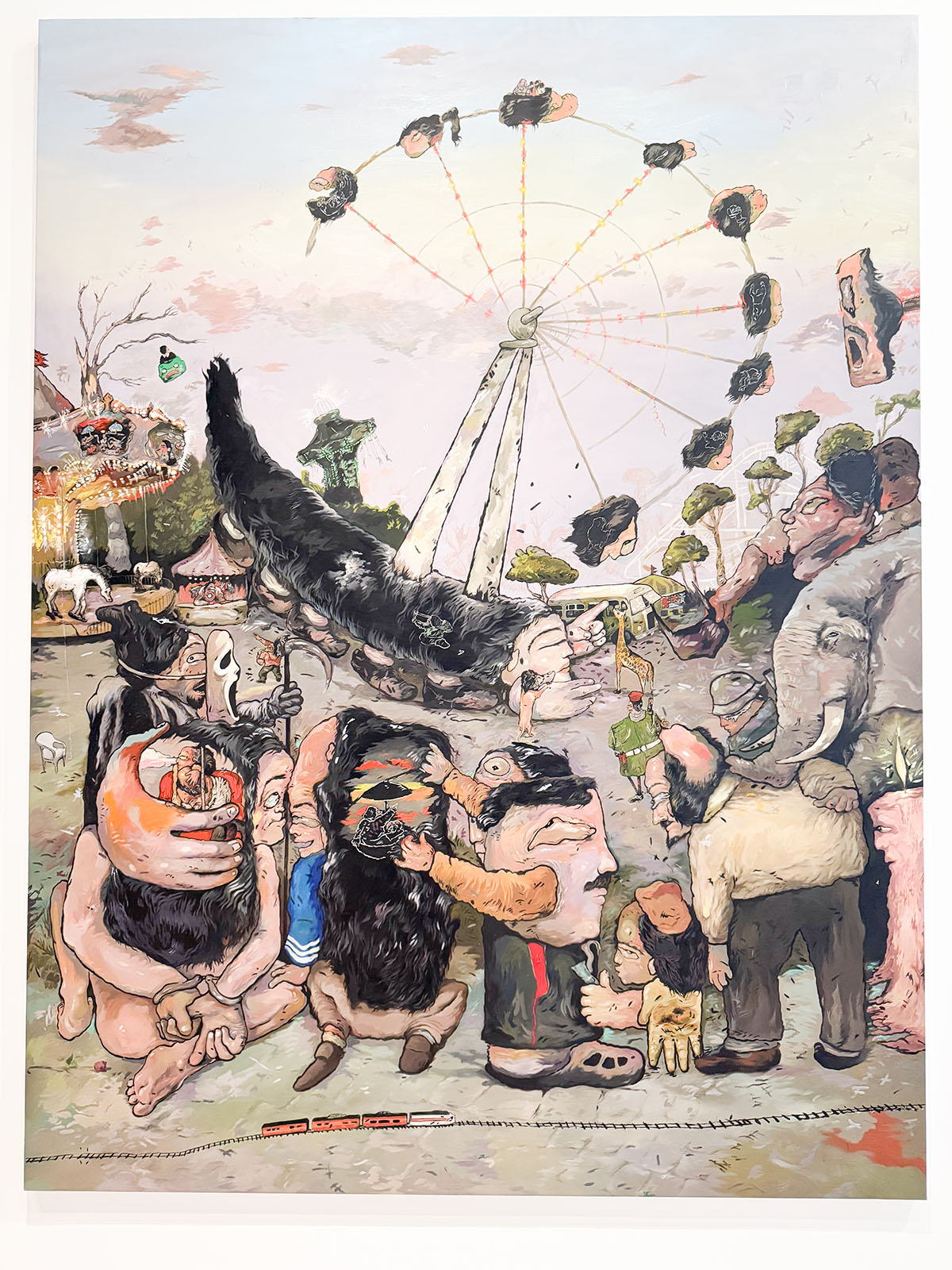
The painting is Look Where I Took You by Ali Eyal, painted entirely from childhood memory. According to the placard, the work reaches back to just before the Iraq War in 2003, when Eyal’s mother took him and his sisters to Baghdad’s largest amusement park so they could see the city one last time before leaving the country. He paints her gesturing toward the city from the Ferris wheel.
Getting as close as I could to really take it in, I felt like I was witnessing a whimsical atrocity. I’m not trying to write fancy. That’s the phrase that erupted into my consciousness. The Ferris wheel gives you a center, but the rest of the canvas feels like memory rebuilding itself through fragments. Fear, family, animals, tenderness, and rupture, all crowded into one frame. Then I read the entire placard and, instead of clearing things up, I found myself arrested by even more questions. The kind of questions that feel like they could only be answered by standing there with the artist and pointing at different parts of the canvas. What’s this? What does that represent? Why this face? Why this corner? And if Eyal replied, “What do you think?” we’d have to square up. Since this scenario of questioning was not an option, I had to stand there and enjoy the surrealism of it while accepting the limits of my own understanding.
Look Where I Took You is in the top three of my favorite surrealist paintings I’ve ever witnessed in person. The only other one that comes to mind when I look at it is The Eternal City by Peter Blume. Another surrealist painting born from watching a country come undone. It’s in the MoMA permanent collection and I always say hello when I’m making my rounds over there. I’d provide the third piece on my list, but that space is reserved for a rotation of paintings I can’t remember encountering and future pieces I’ve yet to be choked by.
The Whitney Biennial’s curators, Marcela Guerrero and Drew Sawyer, framed the whole 82nd edition around mood and texture rather than a single thesis. Tension, tenderness, humor, unease. Eyal’s painting is all four at once. So is Okoyomon’s installation.
Swimming to the Edge of the Pool: “Untitled” (America)
Somewhere in the middle of all this, I hit a section called “Untitled” (America), and it gave me exactly what I needed. It wasn’t part of the Biennial. It’s a presentation of the museum’s collection, named after Felix Gonzalez-Torres’s work of the same title that lights up the museum’s west-facing windows. I liken it to swimming to the edge of a pool to rest my mind. The Biennial enjoys detouring into chaos, and that is part of what I love about it, but after a while you need a wall to hold on to.
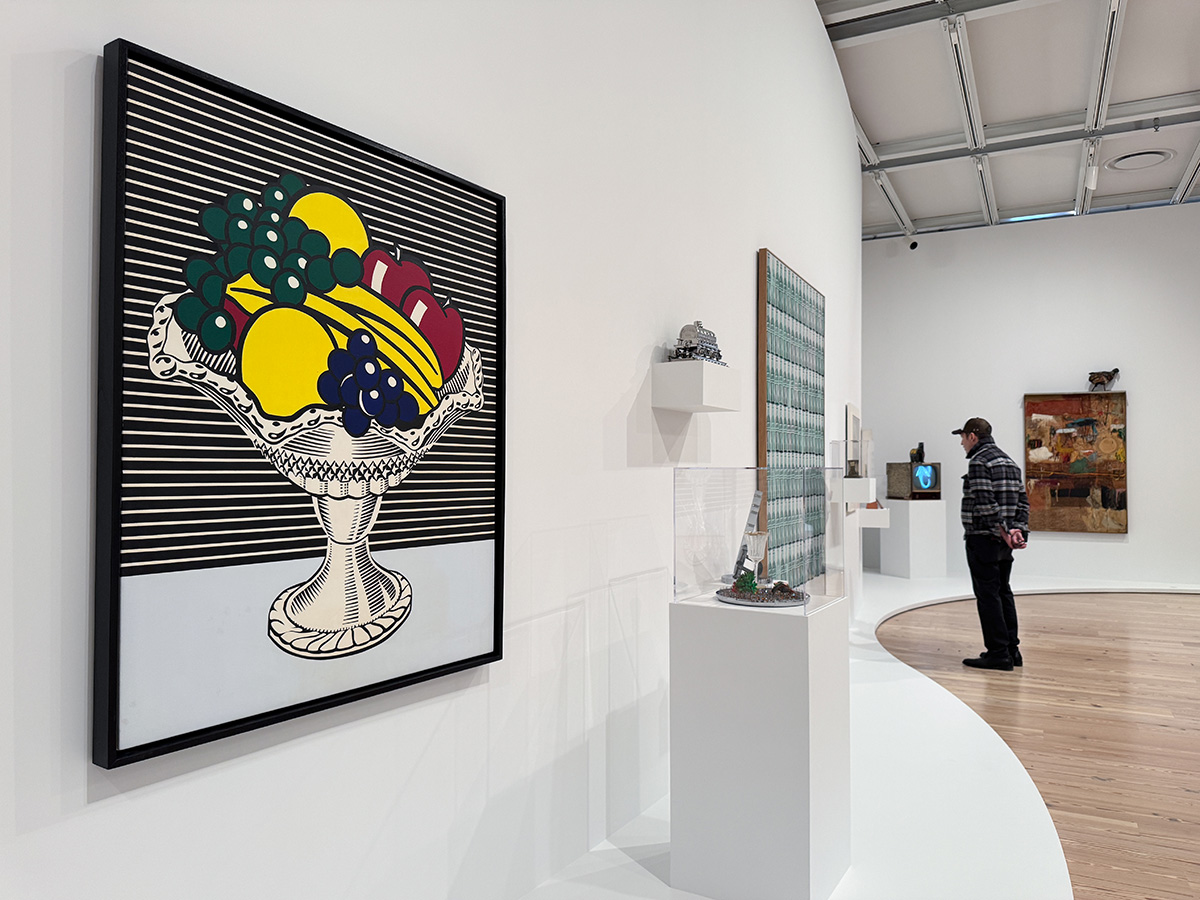
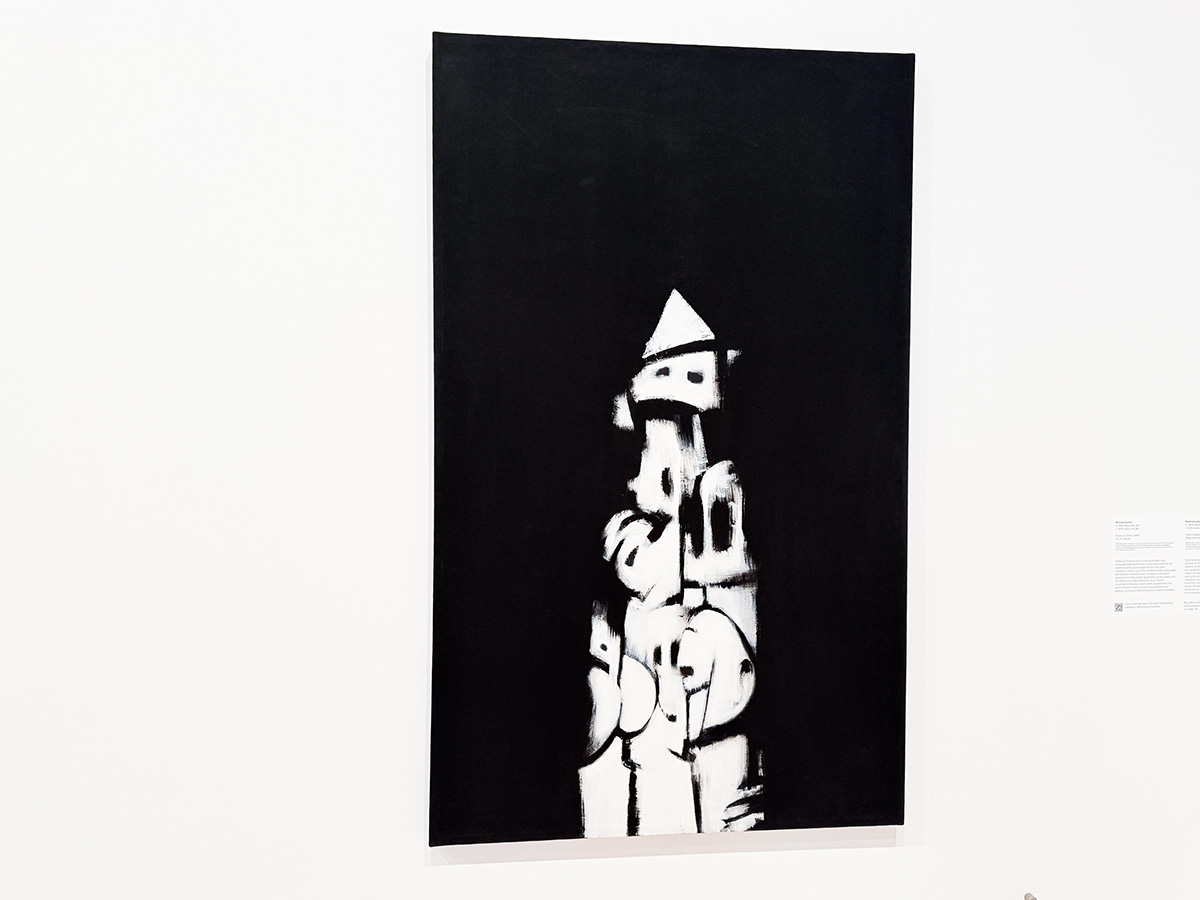
“Untitled” (America) was that wall. Basquiat, Lichtenstein, Koons, Warhol. The Helvetica of the art world. Basquiat’s Hollywood Africans was right there. Warhol’s Green Coca-Cola Bottles was right there. Lichtenstein’s Still Life with Crystal Bowl was right there. But the piece that actually startled me, the one I could see from across the room and know immediately what it was, was Norman Lewis’s American Totem from 1960. Black field with a single white form rising up the center of it.
The placard told me Lewis was one of the few Black artists associated with Abstract Expressionism, and that this painting was part of a series he made exploring the emotional and psychic impact of the civil rights movement. The figure is the hooded Klansman, but the form is something else. It’s a totem of America itself. The nation’s history of terror is both representable and abstract. Conscious and unconscious. Visible and hidden. From way back then to tomorrow’s tomorrow.
Closing Thoughts on the Whitney Biennial 2026
By the time I finished the show, what I appreciated most was the blend of things I understood and things I did not. I am good with that. I’m still a student. I enjoyed being made aware of perspectives I probably would not have arrived at on my own. I enjoyed the moments when the work reassured something I already felt but had not articulated yet. And yes, there were moments when I caught myself thinking, oh word, this is art now? I’m not going to call anybody out, because that’s not what this is. But even that thought felt useful because it reminded me that the lane of what can be defined as art gets wider every year.
That, to me, is one of the points of going to the Whitney Biennial. You go to break free from what you think you know. You go to let other people’s ways of seeing bump up against your own. You go to be challenged, refreshed, confused, reassured, offended, and opened up a little. Art does not always have to be serious in one specific way. It does not always need to be standard or fixed or dressed up in language meant to keep people out. It can be whatever the hell it needs to be. At the end of the day, it comes down to what speaks to you, what moves you, and what you are willing to humble yourself enough to sit with and learn from.
So hey, go.
Plan Your Visit
The Whitney Biennial’s 82nd edition features 56 artists, duos, and collectives across most of the museum’s galleries, and it runs through August 23, 2026. In a place like New York, where everything is overpriced and trying to kill you, it is nice to have a reprieve. It is nice to have a place where you can slow down, look harder, learn, explore, and be vulnerable.