I hopped on the call ready to talk about a photography book. About twelve minutes in, I found out I was talking to two people on their anniversary.
“Today happens to be our thirty-second year anniversary,” Karla said, casual, like she was telling me the weather. I expressed gratitude for them taking the time out to kick it with me on their special day. She waved it off.
“No problem. We went to a diner on our very first date.”
Well, you know what? Of course they did. Thirty-two years ago, James took her somewhere upscale, the kind of place that sends you home hungry. Then an outlaw club. Then, around whatever hour that ends, the famed Coffee Shop on Union Square West, which opened in 1990 and closed in 2018.
Cue screeching tires sound effect, back up. I had to ask about the outlaw club.
“It was like an outlaw club,” James said. “Avenue B and Houston. You’d go and there’d be a van parked. They’d hang a bedsheet on the van with the address spray-painted on it.” He paused. “And then after a while, it’d just be gone.”
That is the whole book in one anecdote, honestly. A city that keeps writing its address on a bedsheet and then disappearing. And two people who have spent twenty-five years trying to get there with a camera before the van pulls off.
This is my third conversation with James and Karla Murray. I keep saying yes to covering their projects because what they do is more than putting pretty pictures in well-designed books. They are historians, if you will. You know, documentarians who happen to carry tripods. Counter Culture: New York City’s Greatest Diners and Luncheonettes, out now from Prestel with text by Emma Orlow, is their eleventh book, and I think it belongs in a time capsule. If this city ever had to be rebuilt from scratch, somebody would need to know what a Formica counter felt like at nine in the morning, and how high the stools sat. That information is in here, captured beautifully.
Ex-girlfriends and college days
The first thing I told Karla and James when we got on was that the book made me think about ex-girlfriends and college days.
She smiled, then laughed and nodded. “That’s the personal connection so many people have to these places. This book has a special place in our heart because it brings back so many memories.”
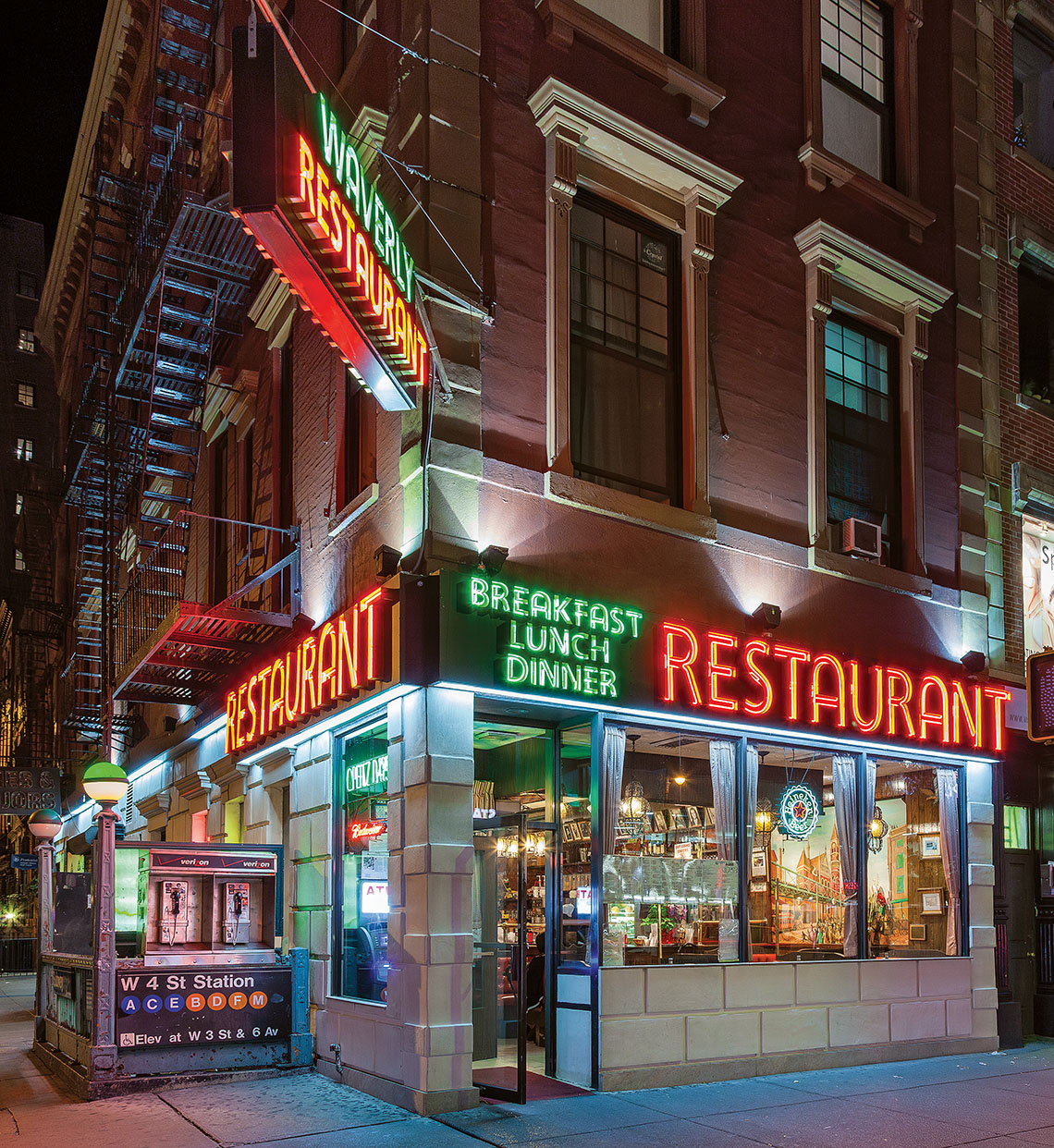
Mine came back in a specific booth. The Waverly, nineties, my friends and I scrunched up in the same seats every time, never in the back, never on the stools. It was conversations about art, poetry, inside jokes, blue jokes and laughter that hurt our sides while blacking out on salty fries that still somehow kept their crunch under an avalanche of Heinz 57 ketchup. My friend Liz once looked across the table at me and said, “You’re the only person I know who will come to the Waverly and drink chicken noodle soup with a glass of zinfandel.”
I had a cold. And back in them days I was fully ensconced in my boxed wine era.
I haven’t been inside in years, because what do I look like going to the Waverly by myself? That place requires the presence of at least one person you actually care about. But there it is in the book, photographed in daylight, which I had never once seen it in, from an angle I never sat at.
Four gone since the shutter clicked
All the interior photography in Counter Culture was shot in 2025. The manuscript went to the publisher in late September of that year. Every single diner and luncheonette in the book was open and operating when the shutter fired.
Four of them are gone now. Hector’s Cafe. Star on 18. Cozy Soup & Burger. Pearl Diner.
“Three of them were standalone diners,” Karla said. “When we say standalone, we mean there was no building above them. There aren’t too many left. And then three of them wiped out, boom, in a year.”
Hector’s hurt. It used to hide in plain sight right under the High Line, and I went there for one thing only, breakfast. It was the oddball holdout after the box stores came, the last room in that neighborhood that still looked like the New York I grew up in.
James and Karla loved it too. They went for the burgers, which came from Weichsel Beef, a few steps away. But listen to what Karla actually remembers about the place:
“We loved their counter seating. The stools themselves were unusual, the shape of the dots. Versus the classic diner stools you see on the cover, which are Veselka’s. These were a little unusual. The cushioning was like a big gumdrop to us.”
Most of us remember a place by what we ate. These two remember it by the geometry of the upholstery.
So what is a diner, actually?
I work on the Upper West Side now. A few blocks from my desk is Barney Greengrass, yet I have never walked in. Never knew what to order. Never made the time.
So I asked them to talk me into it.
“It’s funny you mention Barney Greengrass,” Karla said, “because when we were trying to compile what is a diner, what is a luncheonette, the definition has changed over the years. A lot of people probably wouldn’t think of Barney Greengrass.”
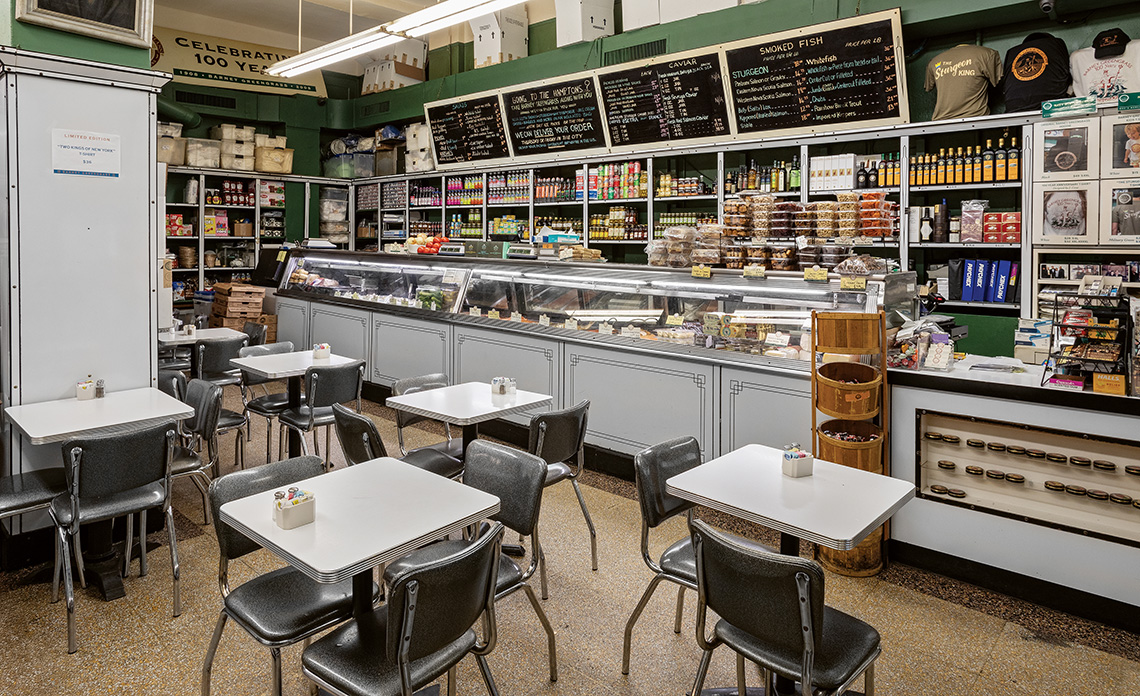
Then she gave me the test they used:
“To us, every diner and luncheonette should have a counter. That’s one of the things when we think about what a diner is. It has that counter where you can see them making something, doing something behind it.”
A surface with work happening behind it and people sitting in front of it. By that standard Barney Greengrass qualifies, and so does Coppelia, and so does Thai Diner. Old John’s on the Upper West Side, which Louis Skibar revamped, has turned its counter into a bar that pulls in a younger, single crowd eating alone. The counter may have evolved, but the counter is still the counter.
I asked which was better, Barney Greengrass or Russ & Daughters for the bagel, cream cheese and lox.
James went “ooh.” Karla laughed and refused to pick.
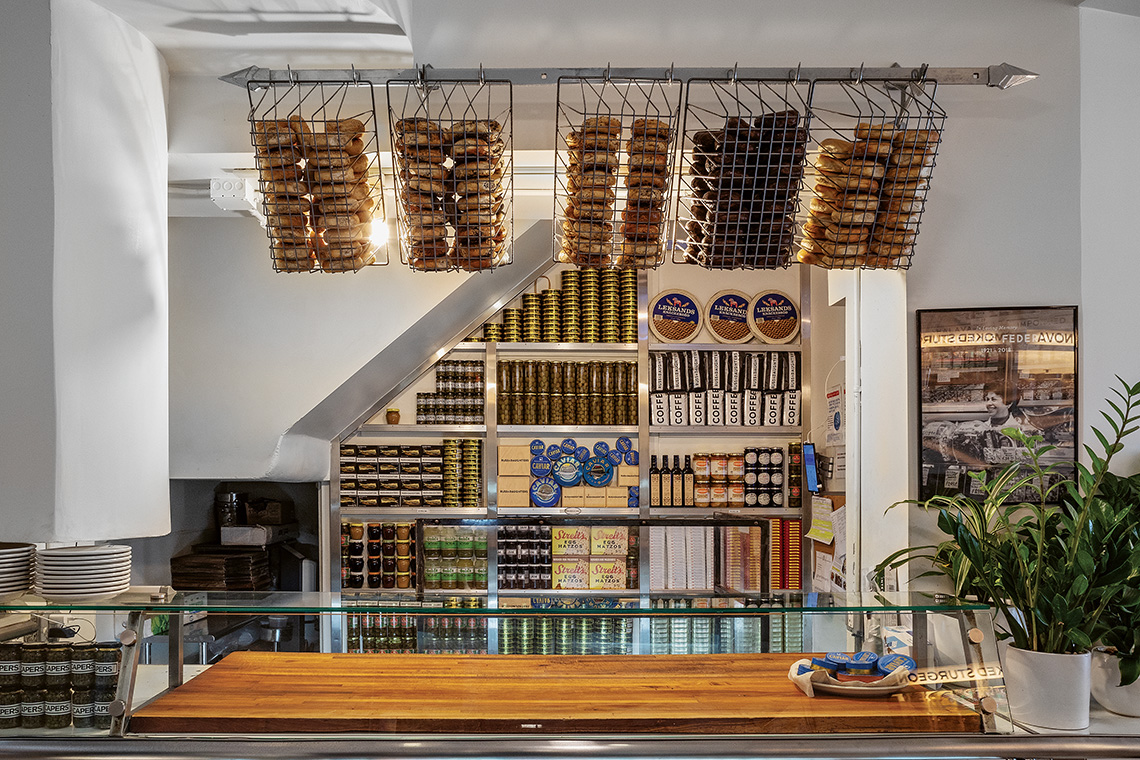
“We’ve never done a side by side. It’s a different experience. At Barney Greengrass it’s that funny banter. Russ & Daughters Cafe, you can tuck yourself away in a booth. You can’t go wrong with either one. If you want to be left alone while you eat, Russ & Daughters. If you want New York talking at you, Barney Greengrass.”
James had the story that decided it for me. They were in there shooting when an older woman walked in with her husband, stopped at the door, and hollered across the entire room: “Where should I put him?”
Where should I put him.
I’m going.
How do you empty a 24-hour diner?
Here is what I noticed flipping through Counter Culture: there are no people in it. Thirty rooms in the most crowded city in America and every one of them is empty.
“We didn’t want people in the photos because we wanted to maintain that timeless atmosphere,” Karla said. “And we didn’t want the people to be the subject. We wanted it to be all about the space, the details. If we put people in there you’d immediately look at the people, and you’d spend less time looking at the details.”
They only shoot during the day.
“You could say, maybe on a 24-hour spot go at one a.m. or two a.m. when there wouldn’t be many people. But no. We want to go during the daytime, because we only use available light. That’s what our photography is about.”
I stopped her. No flash?
“No flashes,” James said.
No introduced light at all. Not a strobe, not a reflector, not a panel. Whatever light is falling into that room is the light in the photograph.
I told them this gave me a completely different appreciation for the book, and I meant it. Because now every image in there is a logic problem. Daylight only. No people. Working business you cannot interrupt. Go.
Here’s how they solve it.
They scout, and they eat the loss. No sun-position apps, no calculators. They go, they look, they decide whether it can work, and sometimes they go home with nothing. First attempt at Barney Greengrass was a washout. Torrential rain, and all the sidewalk furniture had been dragged inside and dumped in the room. “That’s not going to work,” Karla said. “So we had to X that.”
They negotiate the hour with the owner. They ask what day, what time, when’s the lull. A few owners offered 5:30 in the morning, which is generous and useless. “It’s still dark. That’s not going to work for us.”
Rain is a double agent. It softens the light coming through the windows, which helps. It also makes people stay put. “When it’s raining, people tend to linger. They’re not so apt to get up and leave. They’ll order another coffee.”
They wait. Genuinely wait. “We certainly didn’t want to be interruptive of business. This is all supposed to be helping the businesses. Our photography shouldn’t get in the way of the customers.” Sometimes that meant coming back another day. Sometimes it meant sitting there being patient while somebody finished a plate.
And then when the window opens, they move.
I asked about a particular Hector’s frame and whether it was tripod and go. James described the actual sequence:
“One person got up to go to the bathroom. I cleared off our whole table onto the front counter, wiped it down. We have everything set up. We shoot manually, there’s no auto settings, everything is already dialed in and in my head. I dart over with the tripod. I have seven seconds. Boom, boom, boom. We’re done.”
Seven seconds.
At Coppelia it was a guy at the counter who stepped outside to take a call. Karla asked the bartender if she could move his food. The bartender said go ahead. They lifted his plate and his drink, shot the counter, and put everything back exactly where it was. He was on the phone about ten minutes. He never knew.
At Remedy, the manager ran interference. “She said, we’ll seat everybody on one side, you shoot the other side.” Then she flipped it. Then, when they needed one last booth by the window, she went over to a table of neighborhood regulars and asked. The guys knew who James and Karla were, and moved happily. “She knew we only had ten or fifteen minutes before it packed up again. She knows the pace of the place.” Some of those people are thanked by name in the back of the book.
The technical specs, for our fellow photographers:
- 20mm lens. “That has very little distortion. We found it’s the widest you can go on a 35mm camera without fisheye.”
- Fully manual. No auto anything.
- Tripod, long exposures. Three to seven seconds depending on the room. Thai Diner is dark, so it runs long. Remedy is light-flooded from the front and the side, so the shutter can stay quick, which matters when you’re trying not to hold up somebody’s lunch.
There’s an entire philosophy hiding in that last detail. They chose the brighter day in part so the exposure would be shorter, so the disruption would be smaller. The light decision and the courtesy decision are the same decision.
The hundred-year argument
Somewhere in the middle of all this, James said the thing I had been circling the entire conversation.
“A hundred years from now, if the Museum of Natural History wanted to build a diner inside the museum to show how people lived, they could open these pages and say, this is how it was presented.”
I told him the book would be on the mood board and the reference list, and I wasn’t being cute about it.
“For ninety percent of people it’s where you get a hamburger,” he said. “But me and Karla see somewhere that should be revered as art, the way it used to be. Imagine if somebody had done this in the twenties and shown what the bars looked like then. I’d go crazy for it.”
Karla told me about the payphone still mounted in a doorway at one of these spots. She joked with the owner, asked him when it stopped working. He told her the phone company wanted to come take it out and he refused. “We bought that phone. We own it. You can’t take it. It’s staying.”
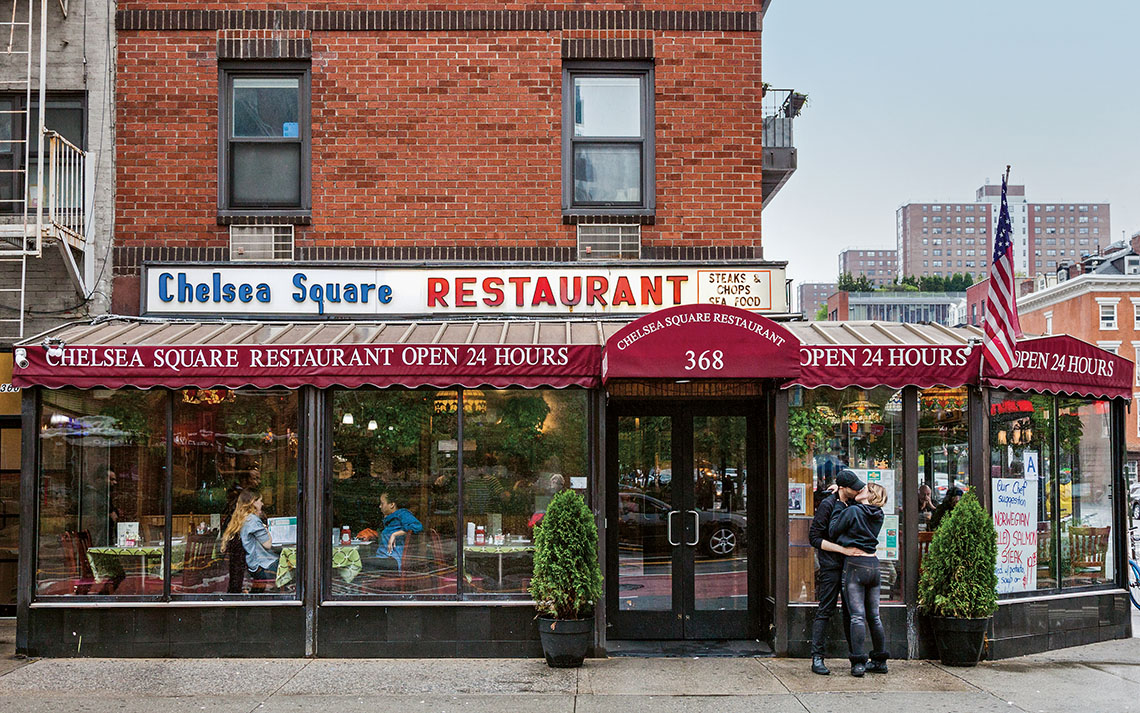
Or Chelsea Square Diner, another 24-hour room, where you may have sat at two in the morning a hundred times and never once looked up at the mugs.
“Those mugs were gifts from customers, given to the owners,” Karla said. “That’s a memory right there. Those people can come back. Or maybe they’ll never have a chance to visit New York again, or they moved away. And that mug is still there. Or it’s a loved one. Maybe the loved one isn’t there anymore, but the mug is.”
You can’t shoot that with a flash. You’d wash it out.
The book as an object
The last few Murray books have been made with Prestel, and you can feel the collaboration in your hands before you read a word. I told them my favorite part is the index, which is a strange thing to say about a photo book, and Karla immediately started giving credit away.
Designer Sebit Min built the type system out of the diners themselves. That black menu board with the white plastic push-in letters, the kind at Lexington Candy Shop. Look at the table of contents on pages fourteen through seventeen: the word “diner” runs diagonally, exactly the way a diner menu board runs “tuna, chicken, egg” down a diagonal so it only has to spell “salad” once. The cover font was chosen to match those little plastic letters pressed into felt. Veselka’s board, which is on the cover, runs straight. The diagonal on the title is a quote from the real thing.
Then Karla made me turn to page fifty-five. EJ’s Luncheonette.
“Look at page fifty-four too. See that material on the bench?”
The booths at EJ’s were reupholstered in 2013 by one of the co-owner’s wives, an interior designer, who picked a vinyl printed to look like worsted wool, the kind of fabric people wore in the thirties and forties. The texture on the cover of Counter Culture is that fabric.
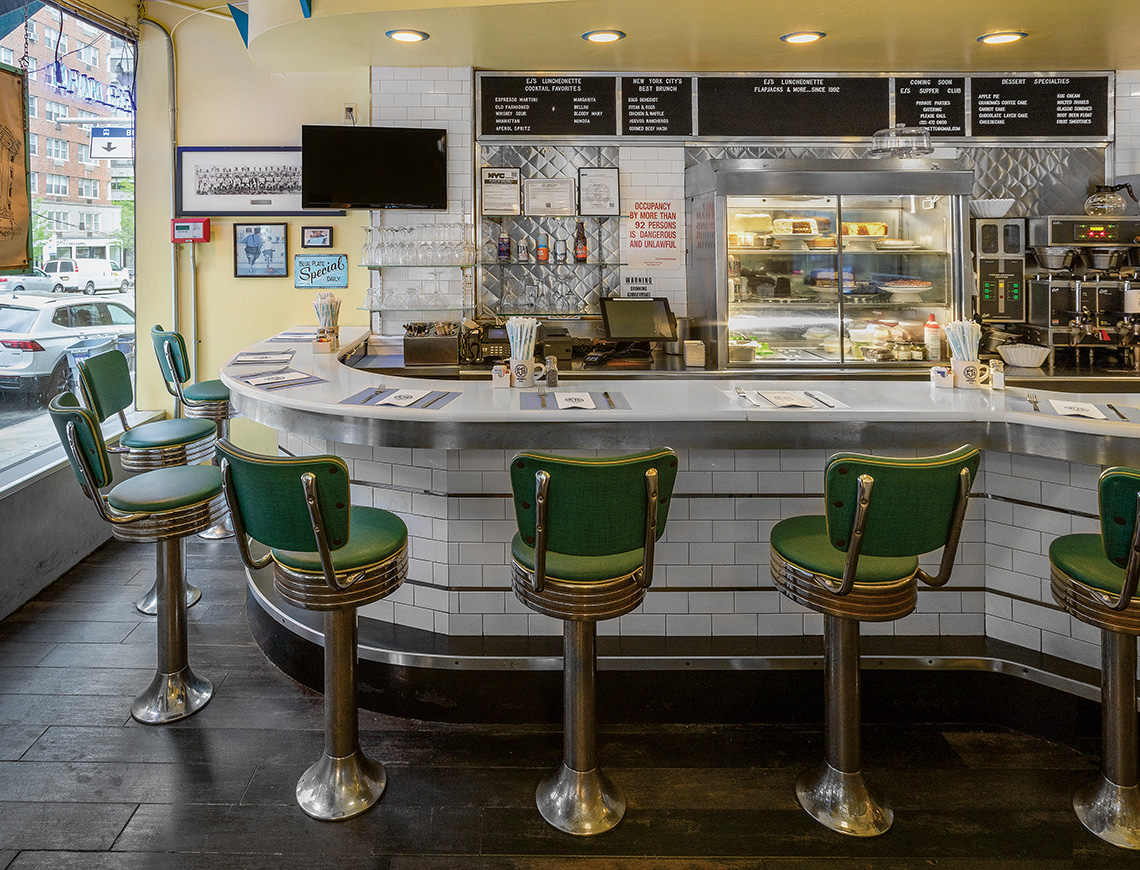
I have been holding the book for a week and I never caught it. That’s an Easter egg in a hardcover.
(I told them the booths also look like the bench seats in the Chevys I photographed in Cuba, which sent us off on a tangent for a minute, as it should.)
Emma Orlow’s text is the other half of it. Karla shouted her out for coming at it from a food-writing background and a younger perspective, and I’ll add my own read: the writing is conversational in a way that photo-book essays almost never are. The first one I turned to was the Waverly, obviously. I did not know it was Greek-owned. I did not know it was originally called Twin Brothers. Huh, go figure.
You can’t please anybody, so don’t try
Thirty entries.
“Our first lists would always make a book that’s a thousand pages,” James said. “You have to narrow it down. Then you start saying, okay, there’s too many from this neighborhood, too many from that neighborhood.”
“And you don’t want too many that look the same,” Karla added. Longevity counts, and so does range.
I told them somebody is going to come for them about a place they left out. Karla was already there: “I know people will say, what about Westway. We know.” And then, flatly: “We’re not trying to make the encyclopedia of diners.”
Back in the day, if you wanted to start a fistfight with your friends, you asked for a top five. Hip hop, rock, anything. Somebody’s list is always wrong and somebody is always ready to slap-box about it.
What I’ll say is that this list reads curated. Lexington Candy Shop, a hundred and one years old and unchanged since 1948, proud of it. Veselka. B&H. Tom’s. Joe Jr., which Karla loves specifically because it sits off the tourist path and off social media, and you watch your burger get made right in front of you. Coppelia, Thai Diner, Golden Diner, Revelie bringing new flavor into an old form.
“That’s really what a diner and luncheonette is to us,” Karla said. “It’s a place where you can go and everybody is equal.”
I said it’s because we’re all hungry.
“You never know who might be sitting next to you. A little old lady from the neighborhood. A movie star. A doctor, a lawyer, construction. You’re all the same sitting at that counter. And watching the short order cook is like tabletop theater.”
Tabletop theater. I told her that cook deserves a stage at Lincoln Center, and I’d buy a ticket. I was in my hyperbole bag that day.
The part about eggs
They shot this book in 2025, which was the year egg prices went insane. Eggs are in damn near everything a diner makes. Breakfast, cakes, pasta, the whole menu leans on that one ingredient.
“At least six owners we spoke to weren’t raising their prices,” Karla said. “They went into their personal savings so they wouldn’t have to raise them, because they didn’t want to alienate their longtime customers.”
Some places added a surcharge because they had no choice. Several just absorbed it. Out of pocket. Quietly.
“That, to me, is a true act of love,” Karla said. “They didn’t want to sacrifice the relationship just to keep the place going, because they know people rely on them. They’re a home away from home. Some people spend more time in their local diner than they do at home. Some of the places we photographed, that’s what we were told. They’re tucked into that corner and they’ll be there for the next seven hours, and everyone leaves them alone, and they’re happy.”
They operate on margins you would not believe and they ate the cost of eggs so a regular wouldn’t feel it.
Eleven books in
Last question I asked: eleven books deep, what’s the most important lesson?
Karla gave me two.
“If you’re thinking about taking a photo, don’t hesitate.”
James, immediately: “Take it. Always carry a camera.”
“You don’t know,” Karla said. “With cell phones that’s easy now, so at least take it with your phone. Document it, because it may not be there. Don’t take it for granted. As much as we hope these places are going to be around forever, they may not be.”
And then the second one, which is really the thesis of their entire career:
“We can say we’re doing what we love, and this is our way of giving back to the city that means so much to us.”
James closed it out the way only a New Yorker can. “New York’s the best city in the world. You’re going to meet the best. Get out from behind your computer. Forget about the phone, go have lunch at one of these places.”
Touch grass, as the kids say.
“And if you can’t physically leave your home,” Karla added, “support your local mom and pop diner. Order from them. Maybe you’ll even make a friend of the delivery person.”
Counter Culture: New York City’s Greatest Diners and Luncheonettes, photographs by James and Karla Murray, text by Emma Orlow, is out now from Prestel. There’s even a map in the back, so cop and go.
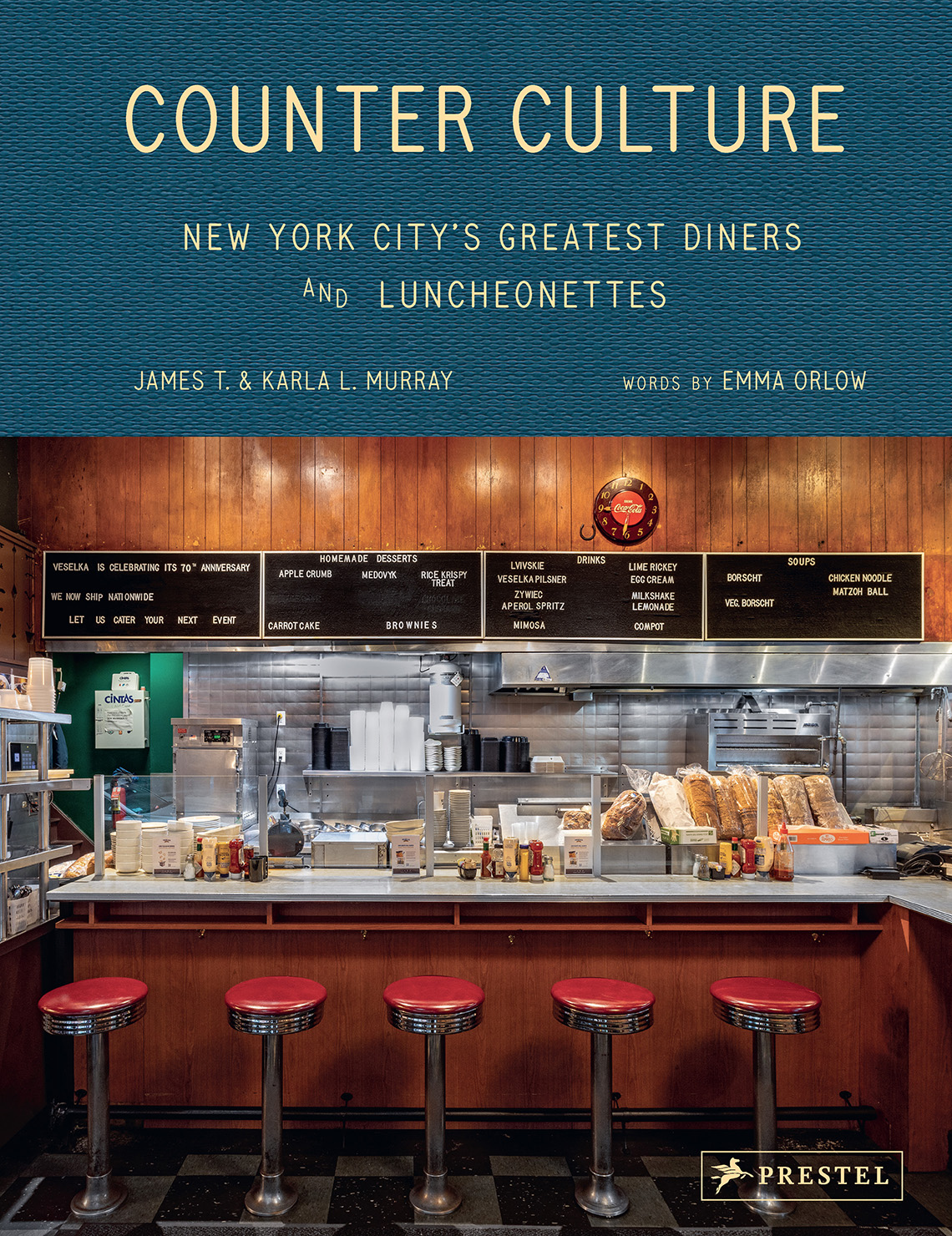
Book: Counter Culture: New York City’s Greatest Diners and Luncheonettes
Photographs by James T. and Karla L. Murray. Text by Emma Orlow. © 2026 Prestel Publishing.
Publisher: Prestel
Photographers: James and Karla Murray
Writer: Emma Orlow